- Each F1 25 lap keeps fuel at its first and last reading, fuel used, the game's MFD fuel estimate, tyre compound and set age, per-wheel wear and inner temperatures, and every pit visit with lane and stationary time.
- Typical consumption is the median of laps that covered at least 98% of the lap with no pit visit and no refuelling — an in-lap or a flashback cannot skew it.
- Laps of fuel in the tank = fuel on board ÷ typical kg per lap. Tyre wear per lap tells you how long a set can last.
- Pit laps stay in the history but never set a pace target, a best sector or the optimal lap.
What the strategy panel shows
Open an F1 25 session and the Fuel, tyres & pit stops panel sits above your laps: three cards for the latest state of the car, a fuel-remaining chart, and a lap-by-lap history underneath.
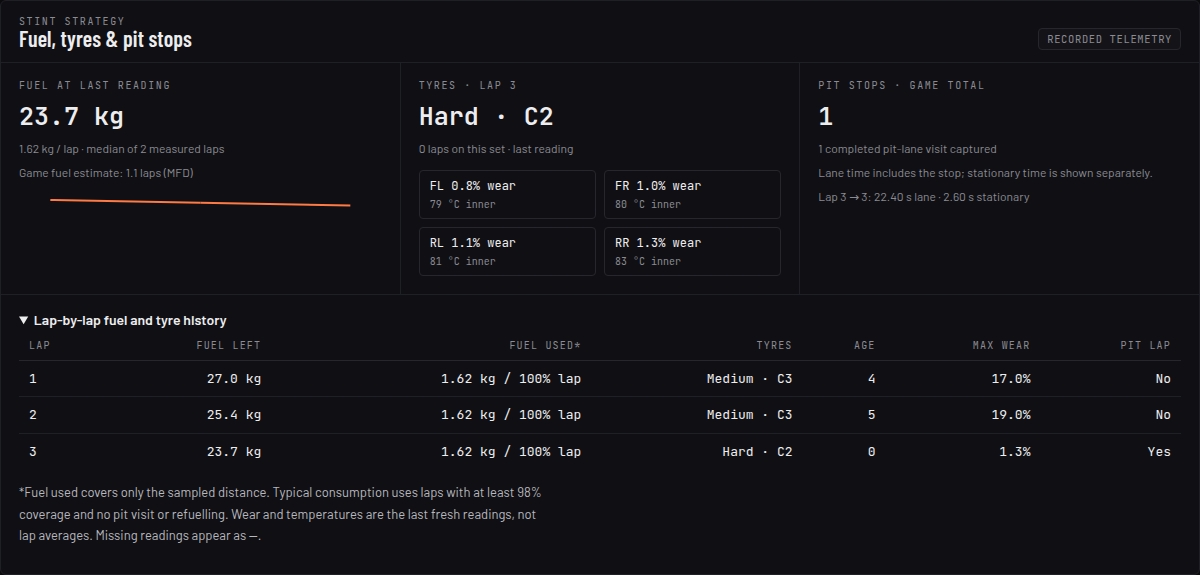
The history table beneath lists, for every lap, the fuel left, the fuel used and how much of the lap that measurement covered, the tyres, their age, the worst wheel's wear, and whether it was a pit lap. The same figures appear in the printable session report.
Fuel: what is measured, and how it is kept honest
For every lap StintLab keeps the fuel in the tank at the first and the last reading it captured, and works out the fuel used between them. It also keeps the game's own fuel figure from the multi-function display: its projection, in laps, of how much fuel you will have to spare — or be short of — at the flag.
A fuel-per-lap figure is only as good as the laps behind it, so the typical consumption is deliberately picky. It is the median of laps that:
- covered at least 98% of the lap between the first and last fuel reading — a lap measured over 80% of its distance used less fuel for less track;
- had no pit visit — an in-lap spends part of the lap at the pit-lane speed limit and burns less;
- had no refuelling — if the tank goes up during a lap, the lap's fuel figure is thrown away rather than netted off.
A flashback inside a lap throws away the readings from before the rewind instead of counting them twice — so that lap's fuel figure covers only part of it and stays out of the median — and a reading that is more than a moment old at the end of the lap is not used. The median, rather than the average, means one odd lap barely moves it. In the screenshot it is 1.62 kg a lap, from 2 measured laps — the third was the pit lap.
Tyres: compound, age, wear and temperature
| Figure | What it is | Worth knowing |
|---|---|---|
| Compound | The tyre on the car, as the game names it — its visual name and its actual compound, such as “Hard · C2” | Both, because the same visual Hard can be a different C-compound at a different circuit |
| Age | Laps on this set | 0 on a new set; a used set keeps its laps |
| Wear | Per wheel, FL · FR · RL · RR, as a percentage | The last fresh reading of the lap, not a lap average |
| Inner temperature | Per wheel, in °C | Also the last fresh reading |
Change tyres and the old set's readings are dropped rather than carried onto the new one, so a lap never mixes two sets. In the screenshot, laps 1 and 2 are on used Mediums (C3) at 17.0% and then 19.0% worst-wheel wear; lap 3 is the pit lap, and the car leaves on new Hards (C2) with every wheel under 1.5%.
Wear per lap is the number that plans a stint. Here it is about 2 points a lap on the worst tyre. Your lap times tell you at what wear level the car starts to lose time — the session's trend, and the laps in the history, show where that is for your car on your circuit — and wear per lap tells you how many laps you have until you get there.
Pit stops, and what they cost
StintLab keeps the game's own pit-stop count and every pit-lane visit it captured: the lap you came in and went out, the time in the lane — which includes the stop — the time stationary, and whether a penalty was served. A visit that spans the timing line is counted once, on exit.
A lap that went through the pits is marked and kept in the history, because strategy needs it. It is never used for pace: not as a target, not for a best sector, not in the consistency figure, not in the optimal lap and not in a practice plan. The in-lap that cost you nine seconds is not a corner you need to practise.
Turning the numbers into a race plan
- Measure in practice, at race pace. Run a long stint in the car and conditions you will race in. You want several full, pit-free laps for the typical consumption, and enough laps on one set to see the wear rate.
- Fuel. Typical kg per lap × race laps, plus whatever margin you are comfortable carrying. Remember the figure is from your pace: a faster, harder-pushing race lap may burn more.
- Tyres. Wear per lap on each compound, and the wear at which your lap times start dropping, give you each compound's useful stint length.
- Stops. Your in-lap and out-lap against typical laps give you the real cost of a stop; a strategy with one stop fewer has to save more than that on track.
- Check it in the race. Afterwards, the same panel shows how the plan went lap by lap — and the next practice session starts from real numbers.
League racers preparing for a fixed race distance will find more in preparing for F1 25 league races.
For F1 fans: what the pit wall is watching
The three numbers in this panel are the ones strategists talk about on every race broadcast. Fuel: a car gets lighter, and quicker, with every lap, so a driver who holds the same lap time late in a stint may actually be slowing down relative to the car. Tyre degradation: the wear and temperatures that decide when a set stops being quick — the reason one driver pits for fresh tyres early to try to gain time on a rival (the “undercut”) and another stays out longer (the “overcut”). Pit loss: the time a stop costs against staying on track, which every strategy call is measured against.
On the broadcast you see the consequences. In F1 25 with StintLab you see the numbers, from your own race. For the rest of the telemetry vocabulary, see the telemetry glossary.
Read this before you count on it
Questions
Which laps record fuel, tyres and pit stops?
New F1 25 laps, in either the F1 25 or the 2026 Season Pack telemetry format, recorded while StintLab is running. Assetto Corsa laps, and laps recorded before this panel existed, show “Not recorded” — StintLab cannot recover telemetry it never received.
Why is a lap left out of the typical fuel figure?
Typical consumption only uses laps whose fuel readings cover at least 98% of the lap, with no pit visit and no refuelling. An in-lap, an out-lap, a lap with a flashback in it or a lap where readings were missing would each skew the figure, so they stay in the history table but not in the median.
What does “1.62 kg / 100% lap” mean in the history?
The fuel used between the first and last fuel readings StintLab captured on that lap, and how much of the lap those readings covered. A lap covered 100% is directly comparable; a lap covered 80% used its fuel over less distance, which is why partial laps are listed but not averaged.
Does StintLab tell me when to pit?
No. It records what the game reported — fuel, wear, temperatures, pit visits — lap by lap, and keeps the arithmetic honest. The strategy call is yours; the numbers are what make it an informed one.
Is the data verified against the real game?
The packet layouts it comes from are pinned by synthetic test fixtures, and have not yet been verified against a live F1 25 session on a racing PC. The waitlist email will say when they have.
Are ERS and battery recorded?
No. This edition records fuel, tyres and pit stops. ERS deployment and battery charge are not recorded.